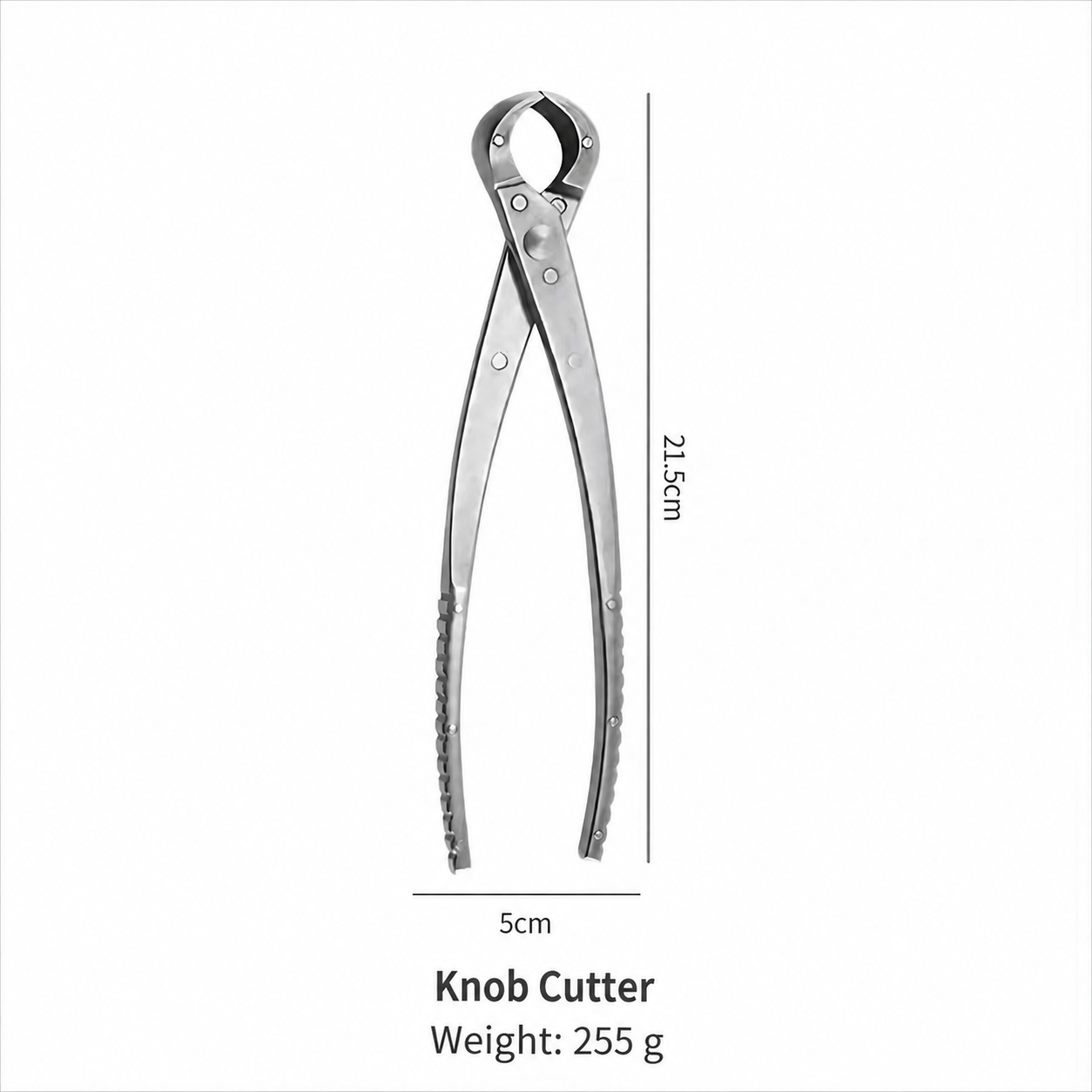
When to use a knob cutter vs concave cutter comes down to what is still attached to the tree. If you are removing a branch at its base, reach first for a suitable concave-style branch cutter. If the branch is already gone and a hard stub, knob, or raised edge remains, a knob cutter may help refine that localized wood. Look at the junction before choosing either tool: the cut you need is more important than the cutter in your hand.
This is a guide to choosing the next action during a real pruning job. If you want the basic head-shape comparison first, read our knob cutter vs concave cutter overview. One naming point: the branch-removal tool in the KADO set is named Oblique Cutter. “Concave cutter” here is a broader category term, not a change to that product name.
Start with the wood in front of you
Before making a cut, ask whether a branch still needs to be removed, or whether you are looking at a remnant from an earlier cut. It sounds obvious, but this is where a lot of tool choices go wrong. A projecting branch calls for a planned removal. A bump left after removal calls for assessment, and perhaps refinement. Those are related stages, not interchangeable moves.
Look closely at the branch collar and nearby growth. Can you see the full cutting head and the tissue you intend to keep? Would closing the jaws hit another branch, or put pressure on the trunk? If the view is poor, change your angle before reaching for a different cutter. A cutter that fits around wood can still be the wrong cutter for that location.
When a knob cutter is useful
A knob cutter earns its place when the problem is a local projection. A short branch stub may sit proud of the surrounding trunk. An older cut can leave a small bump that interrupts the line you are trying to keep. The rounded jaws can approach that raised wood in measured bites. You can remove a little, look again, and decide whether the surface needs any further work.
It may also help clean up a cut made with another tool, but “clean up” does not mean automatically making the wound larger. Check for material that is genuinely raised or torn. If the first cut already has a controlled outline and no problematic projection, leave it alone. Extra bites do not guarantee better healing.
There are cases where a slightly deeper hollow is appropriate for the planned wound shape. This is the knob cutter's more specialized job: taking wood from a compact area without treating the entire junction as a new branch-removal cut. It requires restraint. The useful question is how much wood needs to go, not how deep the cutter can bite. Species and wound response vary, so avoid promising that any recess will become invisible.
For a closer explanation of hand placement and small-bite technique, see How to Use a Knob Cutter for Bonsai.
When a concave-style cutter makes more sense
If the branch is still attached and you have decided to remove it, start with a cutter intended for branch work. A concave-style head is used to make a controlled cut near the attachment. Position matters more than force: the jaws should approach the intended line without levering against the trunk or trapping neighboring growth.
Do not turn “near the attachment” into “as close as physically possible.” You need to see the surrounding tissue and understand the line of the branch. A clean, deliberate cut leaves you more options than an overcommitted one. If the branch is beyond the tool's capacity, forcing the handles is not a test of technique. Choose an appropriate tool or plan the work differently.
The KADO set calls its branch cutter the Oblique Cutter. That name should stay intact when comparing the six tools. Its job in this decision is the initial branch-removal stage; the knob cutter is the optional refinement stage when raised wood remains.
Which tool should you reach for first?
Think in two passes. On the first pass, settle the structural question: is this branch coming off? If yes, plan the position and use the branch cutter when the branch and access suit it. On the second pass, step back and inspect the new surface. If it is controlled and nothing projects, stop. If a distinct stub remains and further work is appropriate, the knob cutter may become useful.
For an existing cut, skip the first pass. Inspect the old wound and the tree's response before removing more material. A protruding stub is a possible reason to use the knob cutter; an uneven surface by itself is not a standing order to cut. Sometimes the best next action is to wait and watch how the tree develops.
A quick field comparison
| What you see | Likely first choice | What to check before cutting |
|---|---|---|
| A branch selected for removal | Concave-style branch cutter; KADO's is the Oblique Cutter | Attachment, access, neighboring growth, and tool capacity |
| A short, raised stub after removal | Knob Cutter, if refinement is needed | How much of the projection is actually unwanted |
| A compact knob or bulge at an older cut | Knob Cutter may help | Tree condition, wound development, and a clear target |
| Small, soft new growth | Neither branch cutter by default | Whether fine scissors suit the task better |
| Training wire to remove | Neither cutting head | Use a suitable dedicated wire cutter |
Can one replace the other?
There is overlap. A carefully chosen cut with one tool may reduce the need for the other. But overlap is not the same as interchangeability. A knob cutter's rounded head can remove localized raised wood; that does not make it the best first tool for every attached branch. A branch cutter can remove a branch cleanly; that does not make its head ideal for every small bump left behind.
If you own only one of them, work within its intended task instead of forcing it to imitate the other. You may leave a small stub for later, or postpone a refinement you cannot make confidently. Bonsai work rarely benefits from the feeling that every mark must be finished in one session.
The fuller guide to six essential bonsai tools shows where the cutters fit alongside Bud Scissors and the wire-working tools. That wider view is useful if you are deciding what belongs in your first kit.
Common mistakes at the cut
Taking a deep bite to save time
A large bite can remove the projection quickly, but it also removes the chance to reassess. Start small where the job allows it. Stop once the specific raised area has been addressed; do not keep cutting because the tool still has room to close.
Refining every new branch cut
A fresh branch-removal cut may already be the result you wanted. Examine it instead of automatically following with a knob cutter. The tree, cut location, and intended outline should drive the next step, not a fixed two-tool routine.
Choosing by handle size
Similar handles say little about where the cutting head can reach or how it closes. Check the jaws and the work area. If you cannot see the edges meeting the intended wood, reposition yourself or wait. Twisting a cutter after it closes is not a substitute for clear placement.
Using either tool on wire or soft tips
These branch tools are not a substitute for a suitable wire cutter, and fine new shoots generally call for a finer pruning tool. Keeping the jobs separate helps preserve the working edges and gives you better control over small growth.
What should a beginner buy first?
Buy for the tasks you can name. Someone doing only light maintenance may use Bud Scissors far more often than either branch cutter. If you are preparing for planned branch removal, a suitable branch cutter is the more immediate need. Add a knob cutter when raised stubs or localized refinement become real, recurring work.
A complete set can be convenient if you already know you will be doing pruning, branch work, and wire work over time. The KADO 6-Piece Bonsai Tool Set includes an Oblique Cutter and a Knob Cutter, along with four other named tools. The point is to have the right head ready when its job appears, not to use all six tools on every tree.
Look at the actual tool photographs and dimensions, then compare them with the trees you maintain. A tool that is useful on a larger branch junction may feel clumsy on a very small tree. “Beginner” describes your experience, not a universal branch size.
FAQ
Can I use a knob cutter to remove a whole branch?
It can bite into wood, but its rounded head is better suited to localized stubs and raised areas. For a planned branch removal, first assess whether a suitable branch cutter gives you a clearer, more controlled approach.
Do I need to hollow every branch cut?
No. Inspect the result before removing more wood. A deeper hollow is sometimes appropriate, but it is not a universal finishing step or a promise of an invisible wound.
What if the stub is too large for one bite?
Do not force the jaws. Work in measured stages only if the material and access suit the tool, checking the remaining shape after each cut. If capacity or placement is uncertain, use a more suitable approach or seek guidance for that tree.
Is KADO's Oblique Cutter the same name as a concave cutter?
No. Oblique Cutter is KADO's product name. “Concave cutter” is used here as a general branch-cutter category term when discussing the choice between branch removal and knob refinement.
When the job is clear, the tool decision is usually simpler: branch still attached, plan a branch cut; localized wood sticking out, consider careful knob refinement. Then look again before doing anything else.