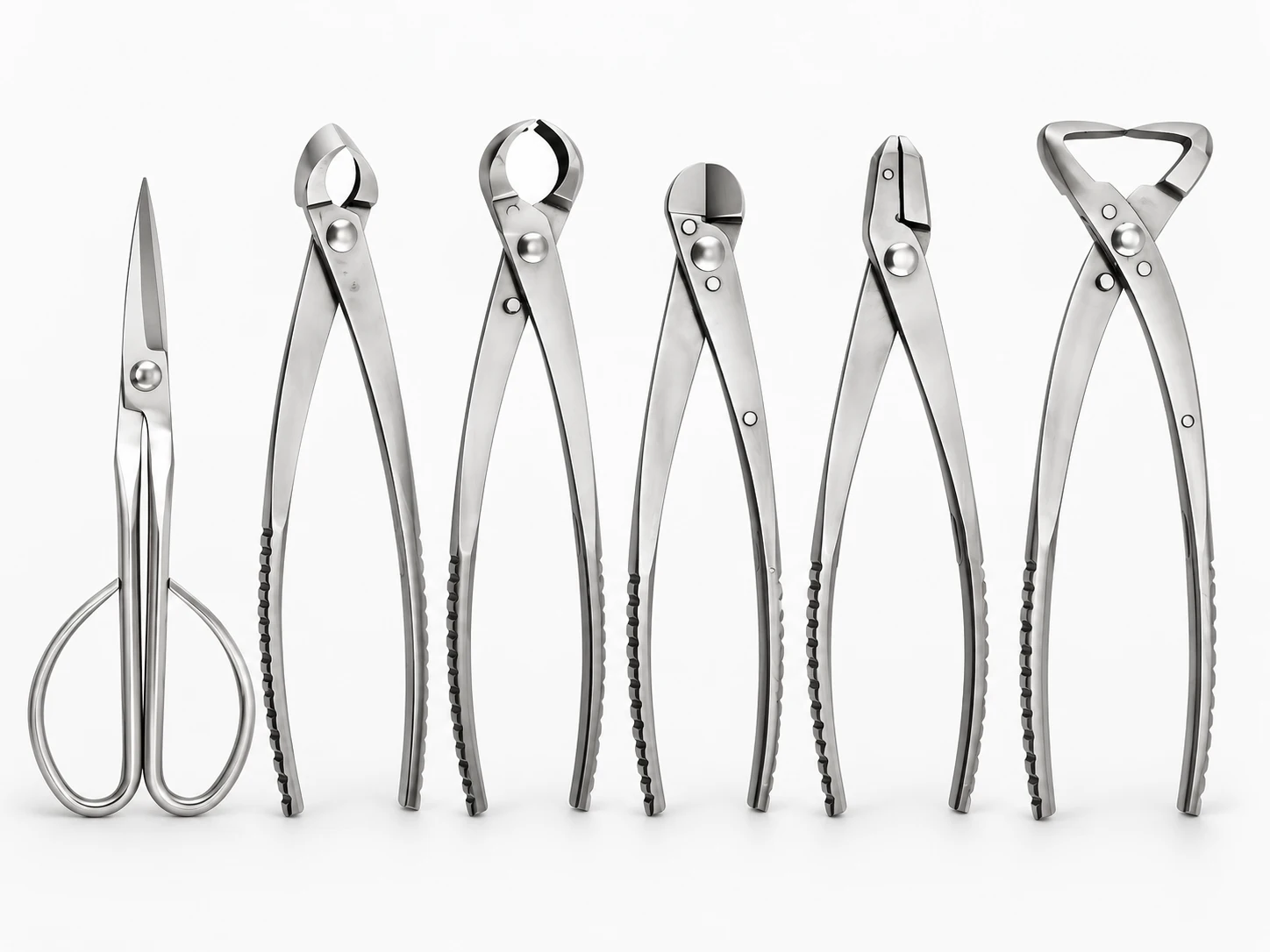
Six useful bonsai tools cover distinct jobs: Bud Scissors trim suitable small growth, the Oblique Cutter handles planned branch removal, the Knob Cutter refines protruding wood, the Branch Splitter supports specialized wood styling, Wire Pulling Pliers provide grip, and the Aluminum Wire Cutter handles compatible training wire. Their jobs overlap less than their similar handles might suggest.
This guide explains what each tool does, when it belongs in your hand, and when to put it down. “Essential bonsai tools” does not mean every tree needs all six at every session. A toolkit may contain tools for years of developing skills, while today’s work needs only one.
1. Bud Scissors
What they are
Bud Scissors are a scissor-style tool for selective pruning of suitable foliage and small growth. The familiar opening and closing action makes them approachable, but placement matters more than familiarity. You should be able to see the part being cut and the neighboring growth you intend to retain.
What they are used for, and when to use them
Reach for them when a planned maintenance task involves trimming an appropriate shoot rather than removing a substantial woody branch. For example, you may have identified a small extension that sits outside the outline you are maintaining. Position the tool for that particular cut rather than sweeping across several shoots simply to finish faster.
A common beginner mistake
Using scissors because they are already in your hand is an easy habit. If the material resists normal, controlled closure, do not turn the handles into a lever. Reassess the material and the task. The right bonsai pruning tools let you keep the work deliberate; they are not a reason to force an oversized cut.
2. Oblique Cutter
What it is
The Oblique Cutter is KADO’s named tool for branch-cutting work. Its cutting head offers a different approach from long scissor blades. Treat the product photograph and actual head shape as useful information, especially when comparing tools from different shops with different naming conventions.
What it is used for, and when to use it
Use it for suitable branch removal when that removal is part of your plan for the tree. Before positioning the head, decide which wood must remain. Consider the approach from more than one angle so the handles and jaws do not push against an adjacent branch while you close the tool.
A common beginner mistake
Removing a branch and then repeatedly deepening the cut because it does not look perfectly smooth can turn a limited job into a larger wound. Tool selection and wound treatment are separate decisions. The correct cutter helps you approach the intended location, but the tree’s response still depends on its species, condition, and care.
If you are comparing branch cutters with rounded-head tools, see our guide to the differences between a Knob Cutter and a concave-style branch cutter.
3. Knob Cutter
What it is
A Knob Cutter has a rounded head that can take localized bites from raised wood. That makes it different from a tool selected primarily to remove a projecting branch. The useful question is whether you are cutting a branch away or refining a particular part of the wood left behind.
What it is used for, and when to use it
Consider it when an existing stub or bulge needs carefully planned reduction. Work only where there is a reason to remove material. A rounded head can be helpful for a localized area, but it does not tell you how deep the final surface should be. That decision requires attention to the individual tree.
A common beginner mistake
Trying to solve an untidy surface with one large bite gives you fewer opportunities to reassess. Another mistake is using the tool simply because the word “knob” appears in the description of a branch junction. First identify what is unwanted and what is living structure that should remain. The correct tool supports precision, not maximum removal.
4. Branch Splitter
What it is
The Branch Splitter is a specialized tool that acts on wood differently from pruning scissors. Its purpose is splitting, not general tidying. It belongs in the part of the toolkit associated with deliberate styling techniques rather than routine foliage maintenance.
What it is used for, and when to use it
It may be used in suitable deadwood or wood-styling work where splitting follows an established plan. This is a technique to learn before applying it to a valued tree. Practice with guidance and understand which part of the tree is being worked, rather than assuming that a split will travel exactly where you want.
A common beginner mistake
A beginner may see an included tool and feel that using it completes the set. There is no need. If your session involves only maintaining foliage or checking training wire, leave the Branch Splitter aside. Choosing not to use a specialized tool is often the clearest sign that you understand its role.
5. Wire Pulling Pliers
What they are
Wire Pulling Pliers are a gripping tool. Their jaws help hold material during suitable wire handling and deadwood tasks. Unlike the cutting tools, their purpose is not to separate material through a pruning edge. That distinction matters when you are laying tools out before starting a job.
What they are used for, and when to use them
Use them when a task calls for controlled grip and you can clearly identify where the pulling or holding force will go. Avoid treating the tree itself as a convenient anchor. Check the contact point, the direction of movement, and whether nearby bark or growth could be pressed by the jaws.
A common beginner mistake
More force does not necessarily mean more control. Pulling against an uncertain attachment or gripping living bark aggressively can cause unintended damage. Stop if you cannot see the contact area clearly. The correct gripping tool is useful because it lets you select a contact point, not because it makes every pulling action appropriate.
6. Aluminum Wire Cutter
What it is
The Aluminum Wire Cutter is the dedicated wire-cutting tool in this collection. Keeping it separate from pruning tools helps you establish a simple workshop rule: do not ask a fine pruning edge to cut training wire.
What it is used for, and when to use it
Use an appropriate wire cutter when preparing compatible wire or removing wire that should no longer remain on the tree. Check the tool’s suitability for the actual material and thickness. A tool’s name or overall length is not a substitute for a confirmed cutting capacity.
A common beginner mistake
Leaving wire removal until the tool is needed immediately can make an otherwise straightforward job awkward. Plan for removal before you start wiring, inspect the tree regularly, and avoid trapping bark between the cutting head and the wire. Dedicated bonsai wire tools help separate metal work from pruning, but careful placement is still your responsibility.
Match the tool to the task
| Task | Tool to consider | Check before starting |
|---|---|---|
| Selective small-growth pruning | Bud Scissors | Clear view of the intended shoot |
| Planned branch removal | Oblique Cutter | Approach, surrounding branches, suitable capacity |
| Localized stub refinement | Knob Cutter | Which wood really needs removal |
| Specialized splitting | Branch Splitter | Technique, tree condition, and a clear plan |
| Controlled gripping | Wire Pulling Pliers | Contact point and direction of force |
| Compatible training-wire cutting | Aluminum Wire Cutter | Material, thickness, and bark clearance |
Turn the list into a workable routine
Before a session, lay out only the tools for the work you have chosen. Separate wire offcuts from plant material. Pause when moving from maintenance pruning to structural work; that change deserves a fresh decision rather than an automatic change of tool.
Afterward, remove residue, dry the tools, and store them where cutting edges will not knock against other metal. Follow suitable cleaning and oiling instructions. A quick inspection before the next use is more useful than discovering a stiff pivot or damaged edge halfway through a cut.
If you are still deciding what to buy first, read Best Bonsai Tools for Beginners. If these six roles match the work you want to learn, the KADO 6-Piece Bonsai Tool Set groups them in one stainless-steel collection for $119. Review the individual photographs and specifications on the product page rather than choosing from a tool name alone.
Questions before you choose
Can I use pruning scissors to cut training wire?
Keep pruning and wire work separate. Use a dedicated cutter suitable for the wire material and thickness instead of using the pruning edges of Bud Scissors.
Is the Branch Splitter for routine pruning?
No. It is a specialized tool for appropriate wood-styling work. Routine small-growth maintenance does not require splitting wood.
Further reading: Bonsai Empire’s tool overview and Bonsai Clubs International’s tool guide.