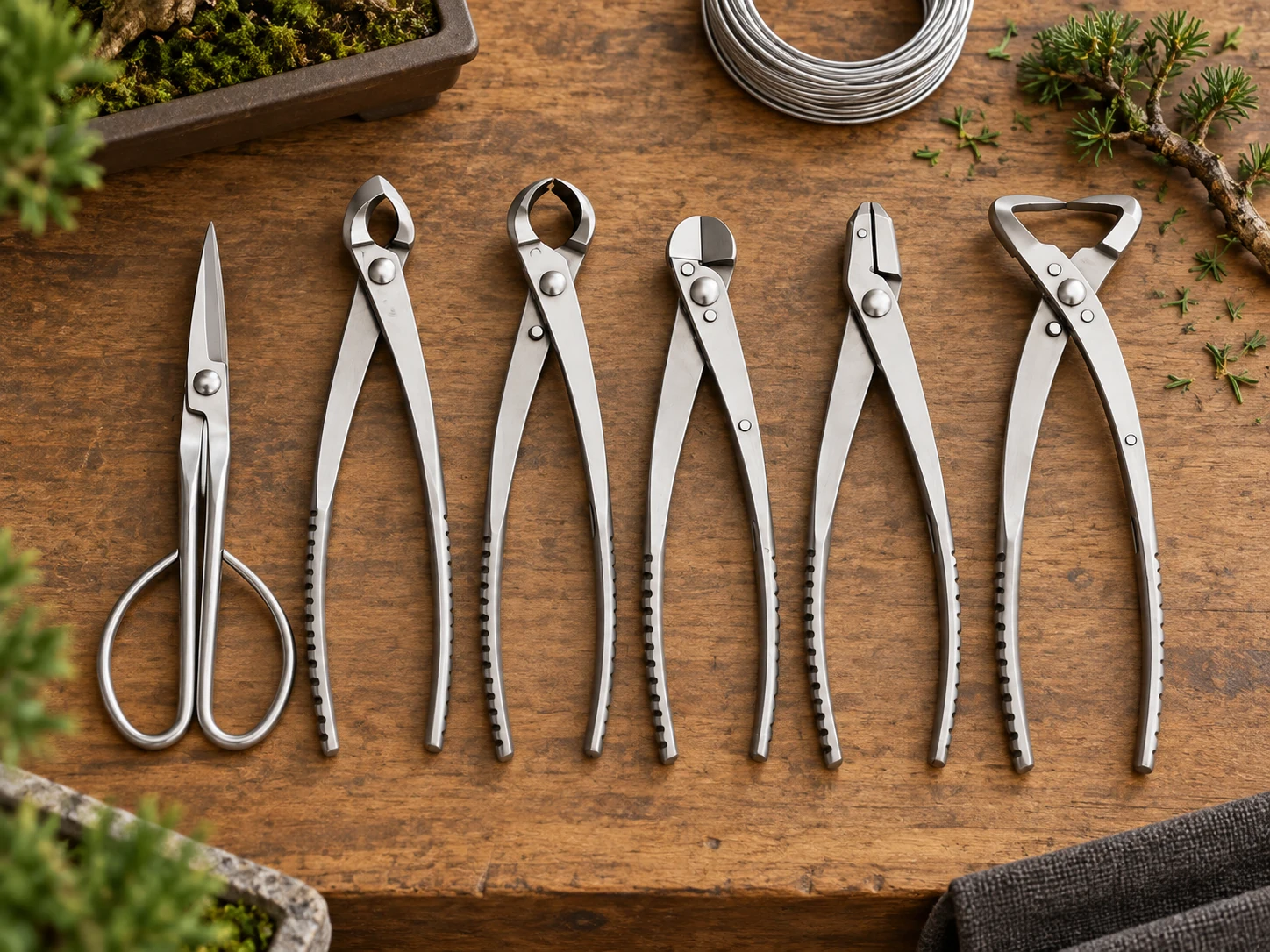
The best bonsai tools for beginners are the ones that match the work your tree actually needs: a precise pair of scissors for small growth, a branch cutter for deliberate branch removal, and a dedicated cutter if you use training wire. More specialized tools become useful as your shaping skills develop. You do not need to use every tool in a set on your first tree.
A sensible starting point is to separate three jobs: maintaining foliage, changing branch structure, and handling wire. They involve different materials and different levels of intervention. Buying around those jobs makes it easier to choose a beginner bonsai tool set without being distracted by the number of pieces in the box.
Why ordinary garden scissors are not the whole answer
A pair of garden scissors can be useful for some simple plant care. The difficulty is access. In a small bonsai canopy, a bulky cutting head may obscure the shoot you want to remove or press against nearby growth. You want to see the intended cut, place the blades accurately, and close them without using surrounding branches as leverage.
Branch work presents a different problem. Removing a branch near its attachment is not the same task as shortening a soft shoot. The shape of the cutting head affects where you can position the tool and the surface it leaves. A dedicated branch tool gives you another option; it does not make every branch removal appropriate.
Wire needs its own tool. Using a pruning edge to cut metal asks that edge to do a job it was not selected for. Keep the distinction simple: foliage tools for suitable plant growth, branch tools for appropriate wood work, and a dedicated cutter for compatible training wire.
Start with the next job, not the largest collection
Before ordering anything, look at your tree and write down what you expect to do over the next few months. Is it mainly growing well and needing occasional tidying? Are you learning how to place training wire? Have you identified a specific branch that might eventually be removed? These are better buying questions than asking which kit has the most accessories.
For a new owner whose immediate work is fine pruning, Bud Scissors are a practical first purchase. If structural branch removal is part of a considered plan, add an Oblique Cutter. If you will wire the tree, have an Aluminum Wire Cutter available before applying the wire, so you have a suitable removal tool when you need it.
A Knob Cutter, Branch Splitter, and Wire Pulling Pliers broaden your options. Their presence in a set is useful for future work, but it is not an instruction to hollow a wound, split wood, or strip bark. Some tools can stay clean and unused until a task genuinely calls for them.
The six tools, in plain English
Bud Scissors: small growth and careful placement
Use Bud Scissors when the task is selective trimming of suitable shoots or foliage. Think of them as your routine pruning tool rather than a small substitute for every other cutter. If you cannot comfortably place the blades and make a controlled cut, stop and reconsider the tool or the approach.
Oblique Cutter: planned branch removal
The Oblique Cutter is the branch-cutting tool in the KADO set. It is useful when you need to work near a branch attachment and have decided that removal is appropriate. For a beginner, the important skill is choosing the cut and approach before closing the handles, not trying to make every wound as deep as possible.
Knob Cutter: localized raised wood
A Knob Cutter has a rounded cutting head suited to removing small portions of protruding wood. It can help refine an existing stub or bulge. It deserves a slower approach than routine shoot trimming because removing more material changes the area permanently. The desired result depends on the tree and the actual wound.
Branch Splitter: a later-stage styling tool
A Branch Splitter serves a specialized role in splitting wood for suitable styling or deadwood work. It is not the first tool most owners need for everyday maintenance. Treat it as an advanced part of a wider toolkit and learn the technique separately before choosing it for a living tree.
Wire Pulling Pliers: grip and control
Wire Pulling Pliers provide a way to grip material during suitable wire or deadwood tasks. They are not cutting scissors, and a strong grip is not the same thing as a gentle one. Consider what the jaws are touching and where the force will go before squeezing or pulling.
Aluminum Wire Cutter: keep wire work separate
The Aluminum Wire Cutter is the dedicated wire tool in the set. Use a cutter appropriate to the wire material and thickness, following its actual capacity rather than guessing from handle length. The product name does not establish suitability for every metal or every wire gauge.
For a more detailed explanation of each job, read 6 Essential Bonsai Tools and What Each One Does.
A useful buying order
| Your next task | Start by considering | What can wait |
|---|---|---|
| Routine small-growth maintenance | Bud Scissors | Specialized splitting tools |
| Planned branch removal | Oblique Cutter | Knob Cutter until refinement is needed |
| Applying and later removing training wire | Aluminum Wire Cutter; suitable gripping tool where needed | Deadwood tools if that is not your project |
| Learning advanced wood styling | Tools matched to the specific technique | Any tool without a clear planned use |
This order is a purchasing framework, not a pruning calendar. Species, growth, recovery, and your intended design determine when work should happen. Owning the correct cutter does not settle those questions. When the next step is uncertain, a species-specific guide or a local bonsai club can be more useful than another tool.
When a complete set makes sense
A set can simplify shopping when you know you want to learn several parts of bonsai work. You can compare one clearly described collection rather than trying to assemble compatible purchases from several listings. It also makes it easier to keep the roles separate: one tool for fine growth, another for branch work, and another for wire.
Compare the contents, not just the piece count. Ask whether the six pieces are six useful tools or a mixture of tools and small extras. Look for individual photographs, clear names, and dimensions you can actually read. A product video can help you understand handling, but it cannot prove how a tool will perform on every tree.
KADO’s 6-Piece Bonsai Tool Set is currently $119 and includes the six tools described here. The tools are made of stainless steel. The product page includes the individual specification images and a branch-cutting demonstration. Compare those details with your planned work before deciding whether a full set or a smaller starting selection suits you.
Build simple maintenance habits from day one
Set up a clean, dry place to put tools down while you work. Keep cutting edges away from hard objects and do not leave wire offcuts mixed with tools meant for pruning. A small habit of returning each tool to its own place makes it easier to reach for the correct one.
After a session, remove plant residue and moisture using an appropriate cleaning method, then dry the tools before storage. Stainless steel still benefits from care. Follow the tool maker’s instructions for suitable oil and cleaning products, and avoid leaving a damp tool in a closed bag.
Inspect the cutting edges and pivot before the next session. A damaged edge, unexpected looseness, or a tool that no longer closes normally deserves attention. Do not compensate by squeezing harder. For a beginner, knowing when to stop is part of learning controlled work.
Before you buy
Choose one upcoming task and identify the tool that serves it. Check the product photographs, dimensions, included items, and care information. Then decide whether you prefer a gradual purchase or a complete set that leaves room for later techniques. Essential bonsai tools should make your work easier to understand, not encourage more cutting than the tree needs.
Questions before you choose
Do beginners need all six tools immediately?
No. Start with the tools needed for your planned work. Specialized splitting and refinement tools can wait until you understand the technique and have a suitable task.
Is the KADO set made of stainless steel?
Yes. The KADO 6-Piece Bonsai Tool Set is made of stainless steel. The product page lists the individual tools and their specifications.
Further reading: Bonsai Empire’s tool overview and Bonsai Clubs International’s tool guide.