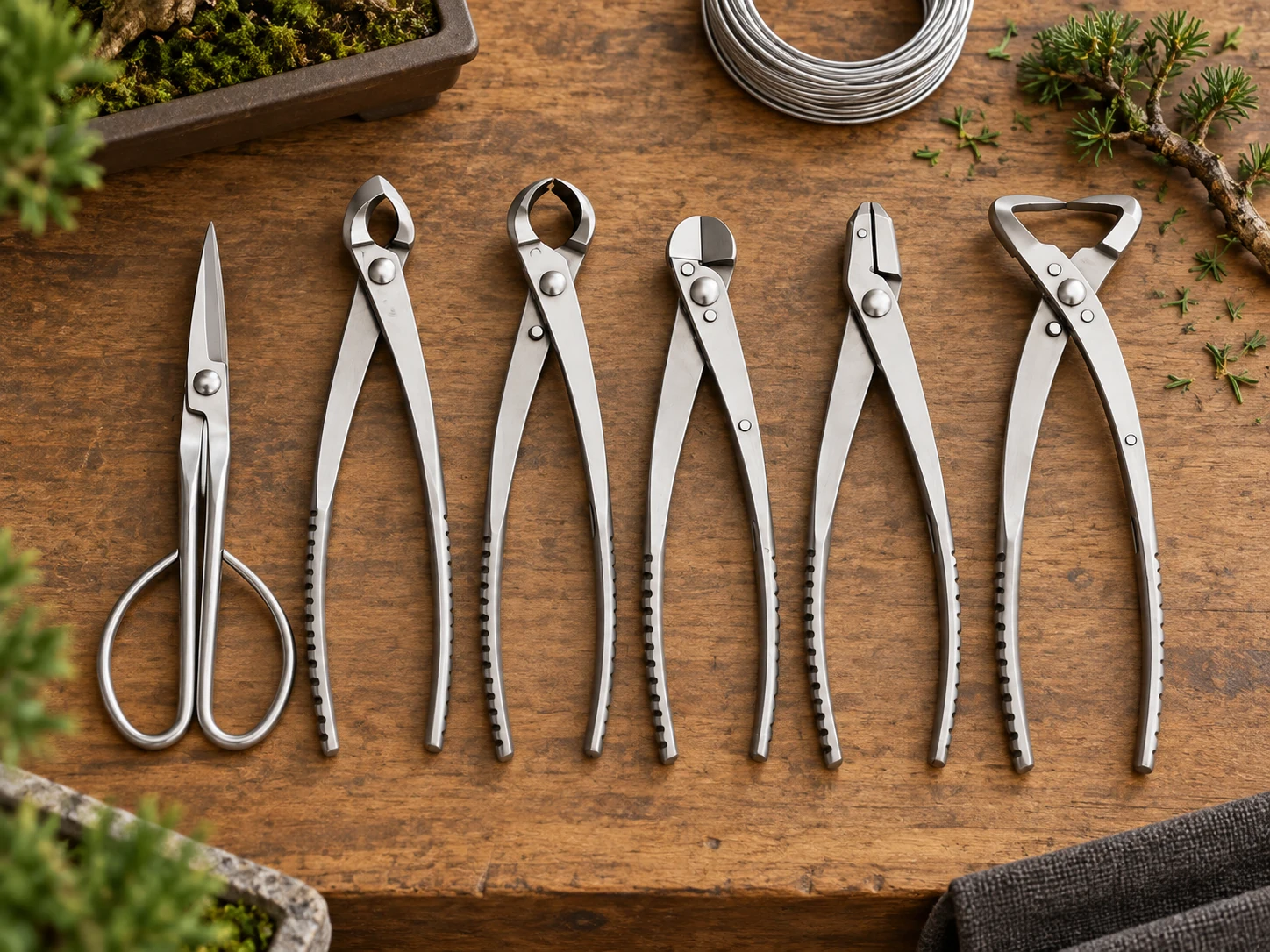
A bonsai tool set makes sense when you are building a toolkit from scratch and expect to prune branches, refine cuts, and work with training wire. Buying tools individually is usually the better route when you already own several useful pieces or know exactly which job is missing from your bench. The right answer depends less on the number of tools and more on the work you plan to do.
That distinction matters because a neat case full of tools can look reassuring even when half of them will sit unused. At the same time, buying one tool after another can become expensive and surprisingly disorganized. Before choosing, list the jobs that come up on your trees: trimming soft growth, removing branches, refining stubs, splitting a branch, positioning wire, and cutting wire. Then compare the list with what you already own.
A set gives you a complete starting point
The clearest advantage of a set is coverage. You can buy once and have separate tools for fine pruning, branch work, and wire work. A beginner is less likely to discover halfway through a session that ordinary scissors cannot safely replace a wire cutter, or that a broad garden tool will not fit into a tight branch junction.
A set is also easier to organize. The tools arrive together, can be stored together, and usually share a similar feel. That consistency is useful while you are learning which cutter belongs to which task. You spend less time comparing dozens of listings and more time understanding the tools in your hand.
Completeness does not mean every tool is needed on every tree. Branch splitting is occasional work. A knob cutter may stay in the case until a raised stub needs refinement. Those tools still have a defined purpose, but their value depends on whether that purpose appears in your practice.
The trade-offs of buying a full kit
The upfront price is the obvious drawback. A set asks you to pay for several tools at once, including pieces you may not use for months. If you only maintain one young bonsai and mostly shorten soft shoots, a complete kit can be more equipment than the current work requires.
A set also limits individual choice. Someone with a strong preference for a particular handle length or cutting-head shape may prefer to select each tool separately. A kit is designed as a balanced collection; it cannot be tailored as closely as a hand-picked bench.
Look at the contents rather than treating “six piece” or “ten piece” as a measure of value. A useful set should divide real jobs among clearly different tools. Extra accessories do not help if they duplicate work or do not suit your trees.
Buying individually keeps the first purchase focused
Individual buying works well when the need is specific. If you already own reliable scissors and wire tools but lack a cutter for branch stubs, buying one suitable cutter is straightforward. You can spend more of the current budget on the tool that will see regular use and postpone everything else.
This approach also lets a collection develop alongside the trees. Begin with the tool needed for routine maintenance, then add another when a new technique becomes relevant. The purchase has a reason behind it, which reduces the chance of filling a drawer with tools chosen before you understood their jobs.
Experienced hobbyists often benefit most from this flexibility. They may want a second pair of scissors for a different kind of work, or a replacement that matches a familiar handle. Buying individually makes those targeted changes possible without repeating tools they already trust.
The hidden cost of building a collection piece by piece
The drawback is that several sensible single purchases can add up. Separate shipping, repeated research, and buying an interim tool before upgrading it can make the final collection cost more than expected. The difference is not guaranteed, but it is worth calculating before assuming that a lower first payment means a lower total cost.
There is also a risk of gaps and duplication. It is easy to buy two cutters with overlapping roles while forgetting a dedicated wire tool. Mixing tools from different sources is not inherently a problem, although handle sizes, opening resistance, and overall feel may vary. Some people enjoy that choice; others prefer a consistent set.
Keep a short inventory before shopping. Write down each tool, its intended job, and whether the current one works well. That simple note prevents the workshop version of buying the same thing twice.
Set or individual tools: a practical comparison
| Factor | Buying a set | Buying individually |
|---|---|---|
| Upfront cost | Higher single purchase | Lower if starting with one or two tools |
| Flexibility | Fixed selection | Choose each shape and size |
| Completeness | Broad coverage from the start | Depends on a careful buying plan |
| Convenience | One decision and coordinated storage | More research and separate purchases |
| Best for | Beginners expecting varied pruning and wire work | People with existing tools or a specific need |
Price still needs context. Compare the actual contents, material, dimensions, and intended uses. Stainless steel describes the material, but it does not tell you whether a particular head shape fits the branch in front of you. A useful comparison is based on function rather than the largest item count.
What usually makes sense for a beginner
For a beginner who expects to maintain several trees, a compact set can remove a lot of uncertainty. It provides a tool for fine shoots, tools for branch removal and refinement, and separate tools for training wire. The set becomes a reference: you learn what each head does before deciding whether a future replacement needs to be longer, smaller, or shaped differently.
A beginner with one small tree and a limited plan can start individually. Bud Scissors may cover routine soft-growth work, while a suitable wire cutter becomes relevant once wiring begins. Add a branch cutter only when the tree and technique call for it. The beginner bonsai tool guide explains how to order those purchases around common jobs.
Do not buy a specialist tool merely because it appears on a checklist. Learn the next technique, inspect the tree, and buy for the work you can identify. Sets are convenient because they reduce missed categories, not because every beginner must use every tool immediately.
What usually makes sense for an experienced hobbyist
If you already have part of a working collection, take inventory before considering another set. Replacing one uncomfortable pair of scissors or adding a Knob Cutter is often more useful than duplicating four tools that still work. Individual purchases let you refine the bench around established preferences.
A set can still make sense as a second kit for another work area, travel, or a clean restart when most of the old tools need replacement. Compare the overlap honestly. If only two pieces fill new roles, price those two separately before deciding.
Experience also changes what “comfortable” means. You may know that a certain handle opening suits your hand or that a narrow head is essential for the species you maintain. That knowledge is precisely what makes individual buying efficient.
How the KADO six-piece set divides the work
The KADO 6-Piece Bonsai Tool Set is one example of a compact, function-based kit. It contains Bud Scissors, Oblique Cutter, Knob Cutter, Branch Splitter, Wire Pulling Pliers, and Aluminum Wire Cutter. The tools cover fine pruning, branch cutting and refinement, controlled splitting, wire positioning, and wire cutting.
That range is most useful when you want those categories available without sourcing each piece separately. If you already own three of them, compare the overlap with the cost and condition of your current tools. Our guide to six essential bonsai tools explains each role in more detail, while the scissors comparison helps with one of the most common first-tool decisions.
A simple way to decide
Write down the next three jobs you expect to perform. Match each job to a tool, then mark what you already own. If the missing items cover several different categories, a well-chosen set is likely the simpler purchase. If there is one clear gap, buy that tool individually.
Check storage and maintenance as well. Six tools are only convenient if you can keep them dry, clean, and easy to identify. A small collection that receives regular care is more useful than a complete set left damp after use.
Finally, leave room for your preferences to change. A first set can teach you what you like. An individually built collection can remain small until the trees demand more. Both routes are sensible when the purchase follows real work rather than an item count.
Frequently asked questions
Is a bonsai tool set cheaper than buying individually?
It can be, especially when you need most of the included tools. Compare the full contents with the same tools purchased separately, including any repeated shipping. If you only need one or two pieces, individual buying may cost less.
Which approach is better for a first bonsai?
Start with the work your tree needs. A compact set is convenient if pruning, branch work, and wiring are all planned. One or two individual tools may be enough when the immediate work is limited to fine maintenance.
Should I replace my existing tools with a complete set?
Not automatically. Keep tools that fit your work and remain in good condition. Price the missing or uncomfortable pieces individually, then compare that total with the useful items in a set.