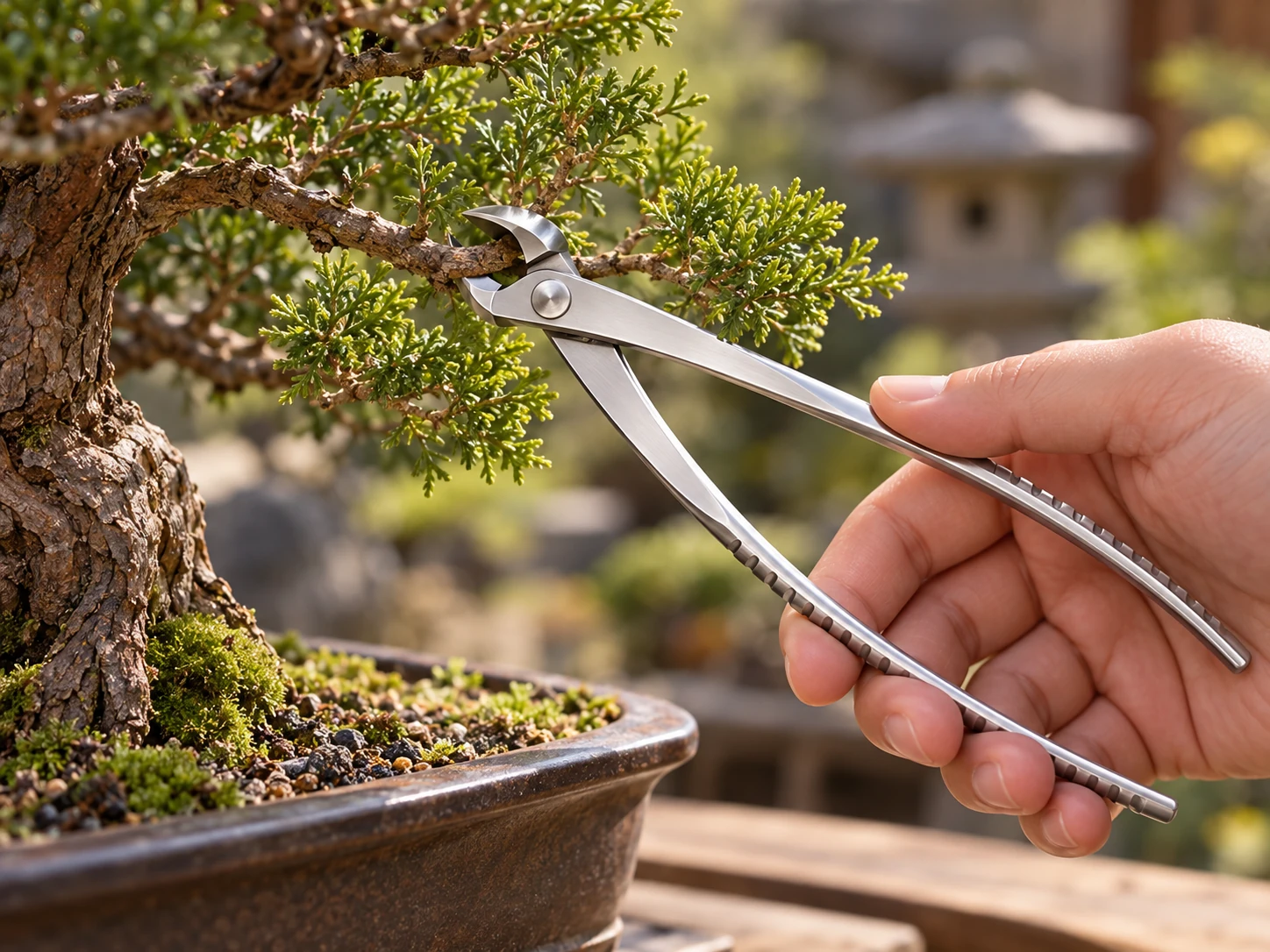
Bud scissors have slender blades that help you reach a small shoot without cutting the growth beside it. Regular pruning scissors usually give you a broader, sturdier head for more accessible stems. For bonsai, the useful difference is access and control, rather than a claim that one pair always makes a better cut.
Look inside a crowded branch pad and the distinction becomes obvious. You may want to shorten one shoot while keeping two nearby buds. A bulky blade can hide the junction just as you are about to close it. A narrow head leaves more of the work visible. Out on an open branch, that extra reach may make very little difference.
Tool names are not perfectly standardized. Some ordinary garden snips also have fine tips, and some bonsai scissors have wide blades. When comparing bud scissors vs pruning scissors, inspect the actual blade shape, how the handles move, and where you need to work. The label alone will not answer those questions.
Blade shape: reach versus support
A typical pair of bonsai bud scissors has long, narrow blades with a fine point. The slim profile fits between leaves and small twigs. It also helps you place the cutting edge near a particular node without pushing neighboring growth out of the way. The tip is useful for positioning; that does not mean it should carry every cut.
Regular pruning scissors often have shorter or wider blades, with more metal supporting the cutting edges. They can feel steadier on an exposed stem and suit general maintenance outside a dense canopy. Garden secateurs are a further category: their curved bypass or anvil heads should not be confused with two-bladed scissors.
There is overlap. A fine-tipped garden snip may handle plenty of small bonsai jobs. A broad pair of bonsai shears may be the sensible choice for stronger twigs. Narrow blades are an advantage when space is tight, not a reason to force them through woody growth they cannot comfortably cut.
Where bud scissors earn their place
Think of an unwanted shoot growing between two shoots you want to keep. Bud scissors let you approach it with less disturbance. They are useful for shortening thin extensions, removing selected soft growth, and working around small leaves where the cutting point would otherwise disappear behind the head.
They also suit detail work near the edge of a branch pad. Rather than sweeping across everything like a hedge, you can follow individual shoots and decide which node to leave. That takes longer than one broad trim, but it gives you a chance to notice a bud facing the wrong direction or a shoot crossing another.
A bud is not automatically something to cut off. Bud selection and pruning methods depend on the species and the tree's condition. Some growth is better handled by pinching or another species-specific technique. Choose the pruning method first, then the tool. Fine blades cannot make an unsuitable pruning decision useful.
Before closing the scissors, make sure you can see both the target and the growth behind it. If a leaf blocks the view, move it gently rather than working by feel. The extra visibility is worth the small pause.
When regular pruning scissors make more sense
On an open shoot with room around it, a sharp, suitably sized pair of regular pruning scissors may do the job well. You do not need to buy a specialist tool merely to shorten a few accessible, soft stems. Comfortable handles and edges that meet properly matter more than branding.
Broader shears can be useful for general trimming where fine reach is less important. Their head may be easier to support on a somewhat firmer twig, provided the tool is designed for that work. There is no universal branch-diameter limit shared by every pair of scissors. Check the tool's intended use rather than guessing from its size.
For a substantial woody branch, stop treating the choice as a contest between scissors. A suitable branch cutter may be needed. If the handles require excessive pressure or the stem starts bending between the edges, reassess before squeezing harder. Twisting the blades to finish a reluctant cut can damage the tool and leave torn fibers.
| Job | Often the better fit | What to check |
|---|---|---|
| One thin shoot inside dense foliage | Bud Scissors | A clear view of the target and nearby buds |
| Accessible soft stems | Either suitable pair | Sharp, aligned blades and comfortable control |
| General trimming with open access | Broader pruning scissors | The tool is intended for the stem being cut |
| Substantial woody branches | A suitable branch cutter | Branch size, attachment, and pruning timing |
| Training wire | A dedicated wire cutter | Compatibility with the wire material and thickness |
Control comes from seeing the cut
The narrow head of bonsai scissors is helpful because there is less tool between your eyes and the shoot. That is especially noticeable when you work close to a branch junction. You can check what will remain instead of simply aiming at the general area.
Open the blades only as far as needed. Bring them around the target, check the position, and close them with a steady motion. Do not use the point as a lever to separate branches. If you cannot get a clean approach, change the viewing angle or move around the tree.
Length is not the only thing to consider. A pair that reaches well but feels awkward in your hand may encourage rushed placement. Try the opening and closing motion before working in dense foliage. The handles should let you stop easily and reposition without brushing the neighboring shoots.
Beginner mistakes are usually about the job
One common mistake is choosing the finest tip for every stem. Fine access and cutting strength are different things. Move a suitable cut farther along the blades when appropriate, and change tools when the growth is beyond the scissors' intended use. Do not turn a delicate pair into a branch cutter by adding force.
Another is trimming a whole silhouette without looking at the shoots underneath. Bud scissors can help with selective work, but only if you slow down enough to select. Pause after a few cuts and look at the branch as a whole. It is easy to remove useful growth while concentrating on one untidy corner.
Keep wire work separate. Cutting training wire with scissors intended for plant material can damage the edges. Root work deserves thought too: soil and grit are hard on fine cutting surfaces, so do not casually move your detail scissors from foliage into a dirty root ball.
Finally, stainless steel does not mean maintenance-free. A tool put away wet or coated in sap may feel worse at the next session. Cleanliness, alignment, and smooth movement are practical habits, not optional finishing touches.
Do you need both types?
If you have one small tree and most work involves accessible soft growth, start with a suitable pair you can control. You can add bud scissors when crowded areas make the broader head frustrating. There is no prize for owning two scissors before either has a clear job.
As your work becomes more varied, a fine pair and a sturdier pair can make sense. Keeping the detail tool for fine growth also helps you avoid using it on everything simply because it is on the bench. For a wider view of the kit, our guide to essential bonsai tools explains how scissors, branch cutters, and wire tools divide the work.
The beginner bonsai tool guide can help you decide what to buy first. If you prefer a set, the 6-Piece Bonsai Tool Set includes Bud Scissors alongside tools for branch and wire work. Look at the individual tools and your planned jobs before choosing.
A simple cleanup before storage
Wipe plant residue from the blades after use. If sap remains, use a cleaning method suitable for the tool rather than scraping the cutting edges with another piece of metal. Dry the scissors thoroughly before putting them away, including the area around the pivot.
Check that the blades meet and the hinge moves smoothly. A small amount of suitable tool oil at the pivot can help when needed; wipe away excess. Store the scissors dry, with the edges protected from knocks. Avoid improvised sharpening that changes how the two blades meet.
The useful test is straightforward: can you see the exact shoot, place the blades without disturbing what you want to keep, and close them comfortably? Bud scissors are worth having when their shape makes that easier. Regular pruning scissors remain useful wherever their head fits the work.
Two practical questions
Can regular pruning scissors be used for bonsai?
Yes, if the blades fit the work and can cut suitable soft growth comfortably. A narrow pair of bud scissors is useful when a broader head blocks access or hides nearby buds.
Are bud scissors suitable for training wire?
No. Keep scissors intended for plant material separate from wire work. Use a dedicated wire cutter suited to the wire material and thickness.
Further reading: Bonsai Empire’s overview of shear shapes and tool uses.