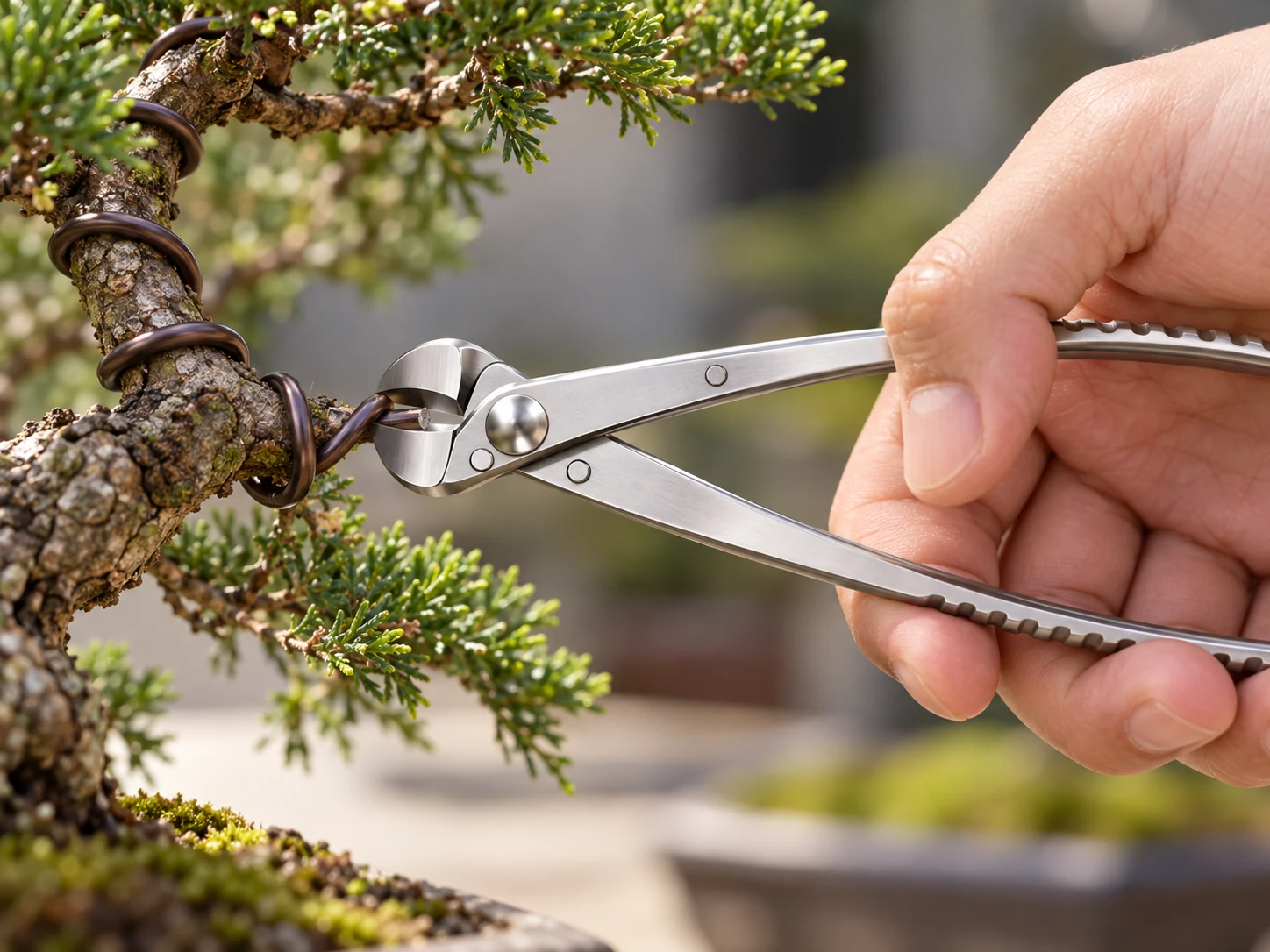
The main difference in a knob cutter vs concave cutter comparison is the job the cutting head is intended to approach. A concave-style branch cutter is commonly selected for branch removal near an attachment. A Knob Cutter has a rounded head suited to taking localized bites from protruding wood, such as a stub or bulge. They can complement each other, but neither is a universal replacement for the other.
One naming detail matters when shopping here: KADO calls the branch-cutting tool in its set the Oblique Cutter. This article uses “concave cutter” for the wider tool category in the comparison, not as a replacement product name. The six KADO tool names remain unchanged.
If you are buying your first bonsai branch cutter, begin with the actual job. Do you need to remove a branch, or has the branch already gone and left an area that needs refinement? That distinction is more useful than choosing whichever head appears stronger in a photograph.
Look at the cutting head before the handles
Long metal handles can make two tools look similar when they are laid side by side. The important comparison is at the working end. Look at the shape of the opening, the curvature of the edges, and how the head would approach the wood. A front-facing photograph alone may not show the full geometry, so use additional views when available.
A concave-style branch tool generally offers a way to approach a branch attachment and remove the projecting branch with a shaped cutting head. Exact profiles differ between designs. Do not assume that every listing using the same category name has identical edges or leaves the same surface.
A bonsai knob cutter usually has a more rounded, enclosing head. It can remove wood from a localized raised area rather than only cutting across a projecting branch. This makes it useful for refinement, but it also means that a small change in placement can change what is removed.
The most useful question is not which tool creates the deepest cut. It is which tool allows you to remove the intended wood while preserving what should remain. Depth is an outcome to control, not a score to maximize.
A simple comparison
| Question | Concave-style branch cutter | Knob Cutter |
|---|---|---|
| Typical starting task | Removing a suitable branch near its attachment | Refining a localized stub, knob, or bulge |
| Head to inspect | Branch-oriented cutting profile; design varies | Rounded cutting head |
| Planning question | Where should the branch be removed? | Which remaining portion needs reduction? |
| Common mistake | Forcing an oversized cut or choosing a poor approach | Removing too much wood while chasing a smooth surface |
| Beginner priority | Often the earlier purchase when branch removal is planned | Useful when refinement becomes a real task |
| KADO product reference | Oblique Cutter | Knob Cutter |
Branch removal and stub refinement are different decisions
Suppose a branch has been selected for removal as part of an established design. The first decision is whether the timing and the tree’s condition make that work appropriate. The next is where and how to approach the branch. Only then does the choice of cutter become useful.
Now consider a branch that was removed earlier and has left protruding wood. You are no longer deciding how to remove the whole branch. You are looking at the remaining shape, the surrounding tissue, and the amount of material that might need attention. A Knob Cutter can be relevant to this second problem.
These jobs sometimes happen in the same session, but they should not become one automatic sequence. A fresh cut does not always need further hollowing. An existing stub does not always need immediate reduction. If the right next step is unclear, leave enough time to assess rather than treating refinement as obligatory.
What people mean by a cleaner wound
In tool discussions, “cleaner” can refer to several things: less torn material, a controlled outline, or the absence of an unwanted projection. None of those descriptions guarantees how a tree will close a wound. Species, vigor, the location of the cut, and subsequent care all affect the result.
It is especially easy to confuse a visually tidy surface with a biologically appropriate one. A deeper recess may look deliberate, yet removing additional living tissue can enlarge the work unnecessarily. Choose the intended result for the tree, rather than trying to imitate a wound shape from an unrelated example.
Tool condition also matters. If an edge is damaged, the jaws no longer align as expected, or normal pressure is not enough, do not solve the problem by twisting the tool in the cut. Stop and reassess. A different tool, a different approach, or postponing the job may be the better decision.
Three practical examples
Example 1: a branch crosses the planned outline
You have identified a branch that conflicts with a considered design. This is a branch-removal question, not simply a knob-removal question. A suitable branch cutter may be the appropriate tool, provided the material is within its capacity and the head can be positioned without crowding neighboring growth.
The important preparation is to inspect the attachment and determine what must remain. Do not choose a Knob Cutter solely because its rounded head appears capable of biting into the same area. Similar access does not make the intended action identical.
Example 2: a small raised stub remains
The projecting branch is already absent, but a localized piece of wood stands proud of the surrounding area. This is the sort of situation where a Knob Cutter may be worth considering. The job is selective reduction of that projection, not removal of another entire branch.
Assess each change as you work. Removing a large amount at once leaves fewer opportunities to reconsider the shape. If you cannot confidently distinguish the unwanted material from what should remain, get guidance on the particular tree before continuing.
Example 3: the working area is crowded
A small tree may have a junction where the handles can move but the cutting head cannot be seen clearly. Neither tool is automatically suitable simply because it reaches the area. Visibility, surrounding branches, and the direction of closure all matter.
Reposition your view and consider whether the planned task should wait. This is also why buyers should compare actual tool dimensions rather than assuming that a larger tool is always more capable. A tool has to fit the work as well as your hand.
Which one should a beginner buy first?
If your immediate work is only trimming suitable shoots, neither branch tool may be the first purchase. Bud Scissors are a more direct answer to that task. If planned branch removal is part of your next stage, a suitable branch cutter generally makes more sense before a refinement tool that has no identified job yet.
A Knob Cutter becomes more useful when you can recognize a localized refinement task and understand the intended result. Buying it as part of a set can be convenient, but there is no obligation to use it immediately. A tool that waits for the right task is doing no harm to your progress.
For a broader overview, read 6 Essential Bonsai Tools and What Each One Does. That guide places both cutters alongside the scissors, gripping tools, and wire tools needed for other parts of bonsai care.
When one cannot replace the other
A Knob Cutter should not be treated as a general-purpose solution for every branch, and a branch cutter should not be forced into a localized refinement task simply to avoid changing tools. The right choice depends on the intended action, not just whether the jaws can be closed around the wood.
Neither tool replaces a dedicated cutter for compatible training wire. Neither establishes the timing for pruning a particular species. And neither makes a branch within capacity merely because you can get it between the edges. Keep these boundaries clear when comparing product descriptions.
What to check on the product page
Look for clear head photographs, readable dimensions, and a description that distinguishes the tools. Be cautious about claims of universal performance or guaranteed wound results. Material information is useful, but it does not tell the whole story of head geometry, access, or how the tool suits your work.
The KADO 6-Piece Bonsai Tool Set includes both the Oblique Cutter and Knob Cutter alongside four complementary tools. It is priced at $119 and made of stainless steel. Use the individual images to compare their shapes and decide whether the collection matches your next projects, rather than buying two similar-looking tools without a reason for each.
The practical takeaway is straightforward: first name the task, then select the cutting head. Removing a branch and refining remaining wood are related jobs, but they deserve separate decisions. That habit will serve you better than memorizing a rule that one cutter is always better than the other.
Questions before you choose
Does KADO call its branch tool a Concave Cutter?
No. KADO uses the product name Oblique Cutter. This guide uses concave cutter as a general tool-category term for the comparison.
Does a deeper cut always give a better result?
No. The appropriate wound shape depends on the tree and the work. Removing additional material just to make a deeper recess is not a reliable goal.
Further reading: Bonsai Empire’s tool overview and Bonsai Clubs International’s tool guide.