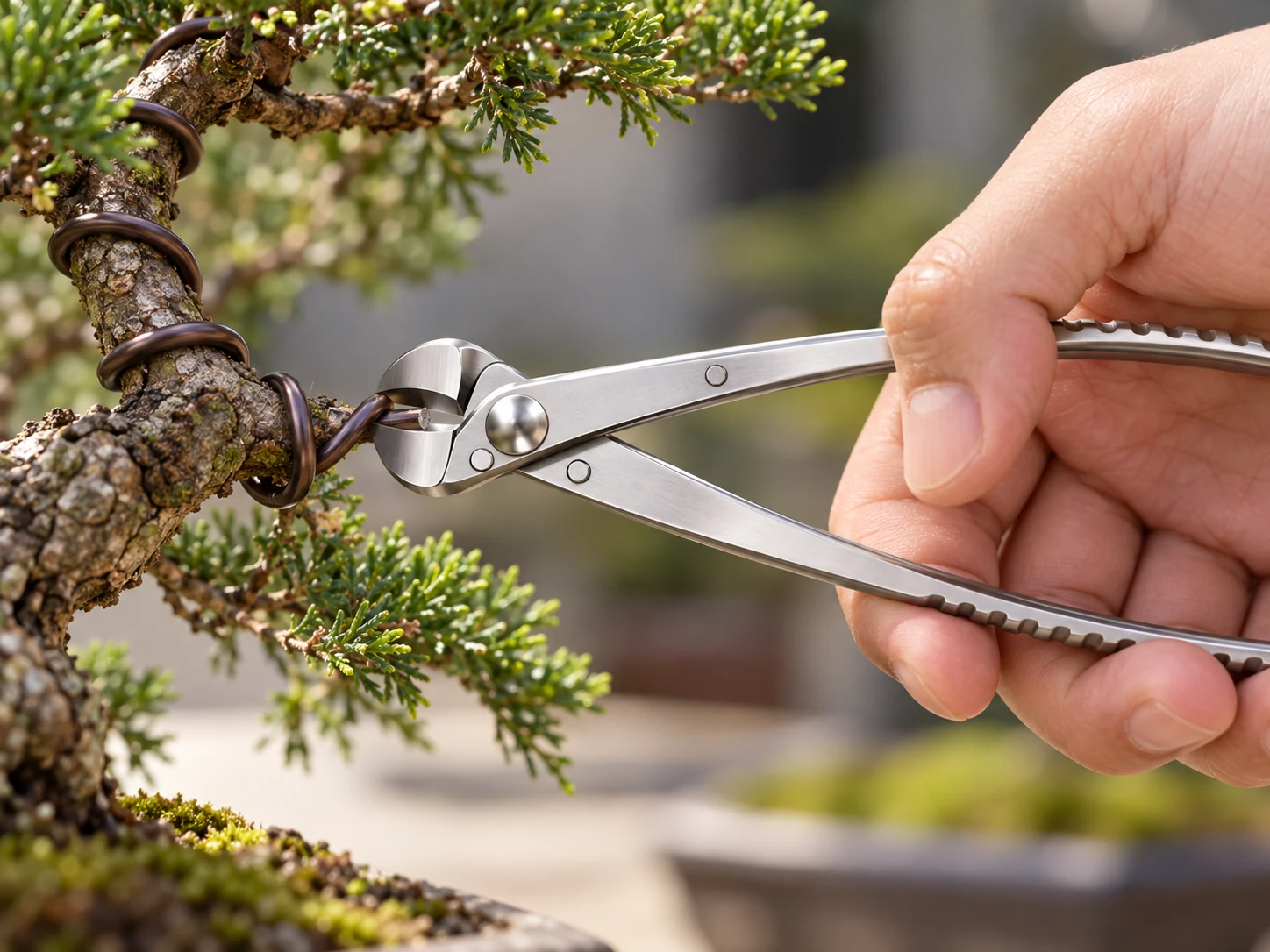
To use a knob cutter for bonsai, place the rounded jaws over a raised branch stub or knob and remove the wood in small, controlled bites. Check the surface after each cut. The usual aim is a modest recess that does not stand proud of the trunk, not a deep hole and certainly not a promise of an invisible scar.
A knob cutter looks a little odd the first time you pick one up. The head is rounded and closes like a pair of opposing scoops. That shape is the point: it lets you approach a small mound of wood from more than one angle and take away a limited amount at a time. Ordinary pruning scissors cut thin growth between two blades. They are useful for shoots and foliage, but they cannot surround a hard branch stub or pare down a bulge close to the trunk.
The tool is simple. Judging the cut is the part that takes care. Before reaching for it, decide what wood actually needs to go and what should stay.
What a knob cutter actually does
After a branch is removed, the remaining base may sit above the line of the trunk. Sometimes it is a short stub left on purpose during an earlier session. Sometimes the branch collar or an old pruning cut has produced a distinct knob. The rounded head of a bonsai knob cutter can take a localized bite from that raised area without needing a long, straight slicing path.
This does not mean every pruning wound should be hollowed out. On many trees, the right amount of work is simply to reduce a projection so the surface is slightly recessed or at least no longer bulky. Species, vigor, branch size, timing and the location of the cut all affect what happens afterward. A good tool gives you control; it does not make the biological decisions for you.
That is also why a knob cutter feels different from scissors. Scissors invite a quick open-and-close motion. A knob cutter rewards slower placement. You look at the jaws, the trunk line and the amount of wood inside the head before applying pressure.
When it is the right tool
The clearest use is a branch stub that remains after the main branch has already been removed. If the stub projects beyond the surrounding surface, the cutter can reduce it a little at a time. It is also useful on a compact knob or localized bulge where a flatter cutting edge would be awkward to position.
On an established pruning site, you may use it to refine an uneven edge or remove a small high spot. The goal is a cleaner, more controlled surface that gives the tree a reasonable shape to grow around. “Cleaner” should not be confused with “completely scarless.” Large cuts remain large cuts, and even careful work can stay visible for years.
There are days when the best decision is to leave the stub alone. If the tree is weak, the work is poorly timed for that species, or you cannot see the attachment clearly, put the tool down. Nothing is gained by making a confident cut in the wrong place.
When to leave the knob cutter on the bench
For thin green shoots and routine maintenance pruning, use suitable bonsai scissors. The rounded jaws of a knob cutter are clumsy around delicate growth and give you less visibility than a narrow pair of blades.
Do not use it on training wire. Wire can damage an edge intended for wood, and the rounded head does not give the same controlled access as a dedicated wire cutter. It is also a poor choice for blindly forcing through a thick branch. If the wood does not fit comfortably, or closing the handles requires excessive effort, stop and reassess the job.
A common temptation is to use the knob cutter simply because it is already in your hand. Resist that. Bonsai pruning tools overlap, but each head shape makes some jobs easier and others needlessly awkward.
How to use a knob cutter for bonsai
Read the branch base first
Brush away loose debris and look at the branch from more than one side. Find the line of the trunk and the point where the unwanted wood begins. If a branch is still attached, decide whether it should first be shortened or removed with a more suitable branch cutter. Trying to take a whole branch in one knob-cutter bite can pull the head away from the place you meant to cut.
Set the jaws before you squeeze
Hold the tool so you can see both sides of the head. Support the pot or trunk as needed without pressing on fine branches. Place only the wood you intend to remove between the jaws. At this stage, I like to close the handles just enough to feel where the edges will meet, then open them again for one last look.
Take a small bite
Close the handles with steady pressure. Do not twist the tool while the jaws are buried in the wood. After the first bite, pull the cutter away and inspect the area. A small cut may look cautious, but it leaves you options. A cut that is too deep cannot be put back.
Work around the raised portion rather than repeatedly attacking the center from the same angle. On a stubborn stub, two or three modest bites often give better control than one dramatic squeeze.
Stop when the shape is right
Look across the trunk rather than only straight at the wound. If the former stub no longer projects and the surface has a slight, controlled recess where appropriate, you may be done. Do not keep cutting because the tool still has room to close. The question is whether more wood needs to go, not whether more wood can go.
If you become unsure, stop. Change your viewing angle, clean away loose fibers and check again in good light. Repeated little cuts made without a clear target are how a tidy adjustment turns into an oversized wound.
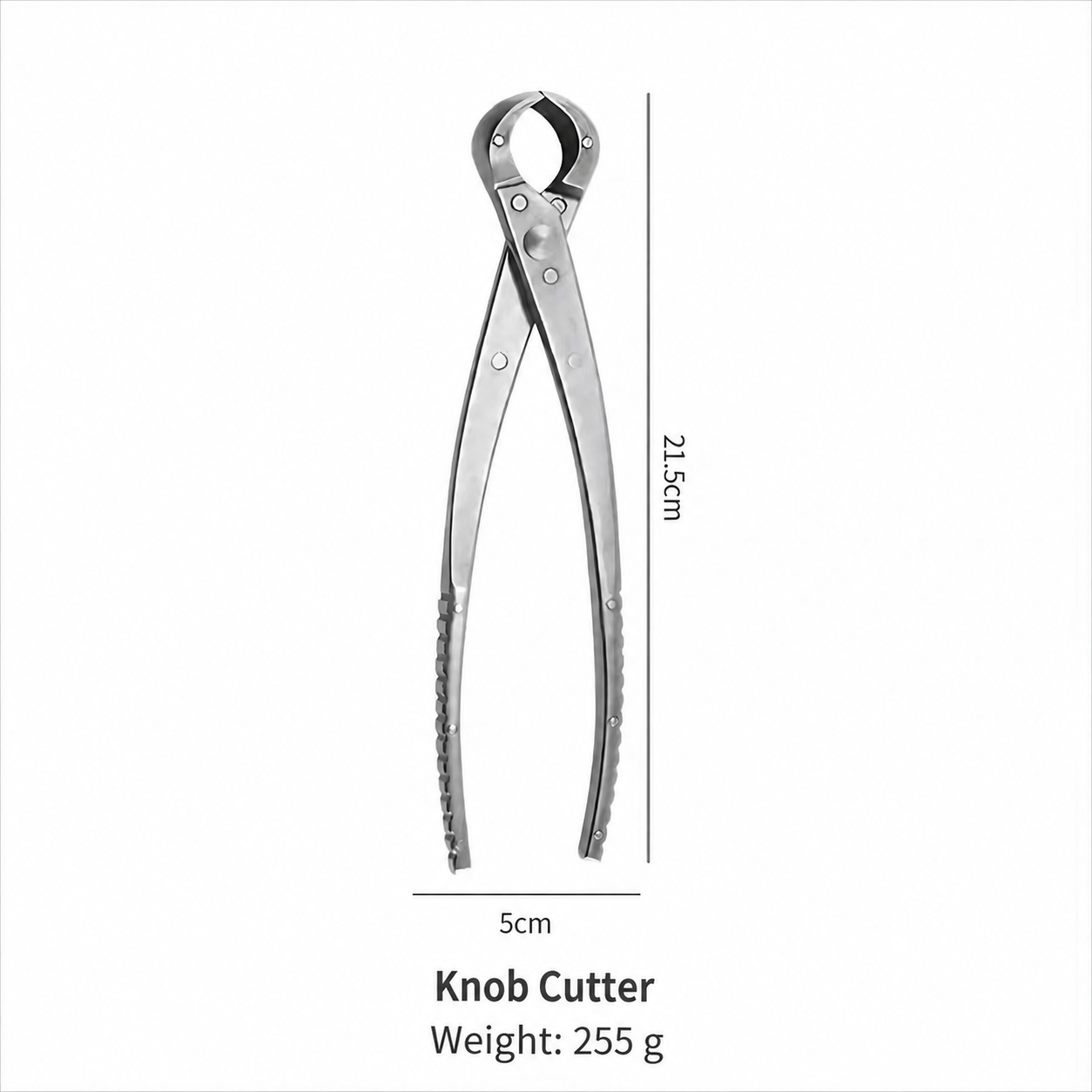
If you prefer having the main pruning and wire-working tools in one kit, our 6-Piece Bonsai Tool Set includes a knob cutter along with the other core tools.
Mistakes that make the job harder
The classic beginner mistake is taking one deep bite because the stub fits inside the jaws. Fit is not the same as a cutting plan. Start near the high point, remove a small amount and check the result.
Another mistake is treating the tool like general-purpose scissors. A knob cutter is not pleasant for clipping many small branches, and moving quickly through a canopy makes it easy to catch something behind the intended cut. Use it when you have one specific raised area in front of you.
Pay close attention to the branch-to-trunk connection. If you cannot tell where the stub ends and the trunk begins, more pressure is not the answer. Improve the view or postpone the cut. Chasing the deepest possible hollow is equally unhelpful. The deepest cut is rarely the best measure of careful work.
Knob cutter vs concave cutter
These tools do overlap, and experienced growers may use both during the same piece of branch work. Their head shapes, however, encourage different approaches. A concave-style cutter is commonly used to remove a suitable branch near its attachment. A knob cutter has a rounder, more enclosing head that is handy for reducing a remaining stub, knob or small bulge.
Neither description is an absolute rule. Tool designs vary, and access around the branch may decide which head works better. Think of branch removal and stub refinement as related stages rather than a contest between two cutters. Our fuller knob cutter vs concave cutter comparison looks at those differences in more detail.
If you are still sorting out the rest of the kit, the guide to six essential bonsai tools explains where scissors, branch tools, pliers and wire cutters fit into a normal working routine.
Clean it before putting it away
Wipe the jaws after use, especially if they have picked up sap or damp wood residue. Dry the tool before storage and keep it somewhere that does not stay humid. Every so often, check that the pivot moves smoothly and give the hinge simple maintenance with a suitable tool oil when needed.
Look over the edges and alignment while you clean. If the jaws are damaged or no longer meet as expected, address that before the next pruning session. A quick wipe and inspection takes less time than discovering a problem while the tool is already around a branch.
The practical habit is straightforward: identify the raised wood, place the head where you can see it, take less than you think you need, and stop to look. That pause between cuts is what makes a knob cutter useful.
Questions before you choose
Should a knob cutter leave a deep hollow?
Usually, no. The aim is a controlled, slightly recessed surface where appropriate, not the deepest possible hollow. Stop and inspect the cut before removing more wood.
Can I use a knob cutter on training wire?
No. A knob cutter is intended for wood. Use a suitable dedicated wire cutter for training wire so you do not damage the knob cutter’s edges.
Further reading: Bonsai Empire’s tool overview and Bonsai Clubs International’s tool guide.